Positive reinforcement means a child receives something motivating after a target behavior, making that behavior more likely to happen again. In early ABA therapy, that reinforcement is usually immediate and frequent: a token, praise, or preferred activity after nearly every success.
As a child moves toward classroom readiness, the reinforcement schedule has to change too.
Cardinal Pediatric Therapies builds that shift deliberately, rather than leaving a child to encounter it cold on the first day of school.
How Reinforcement Schedules Change as a Child Prepares for the Classroom
Early skill acquisition typically starts with continuous reinforcement, a reward after every single instance of the target behavior because it makes the connection between behavior and outcome as clear as possible.
Reinforcement procedures and schedules of reinforcement are core, tested competencies for behavior analysts under the Behavior Analyst Certification Board’s official Task List, and this shift from continuous to intermittent reinforcement, sometimes called schedule thinning is one of the core mechanics BCBAs use once a skill starts to stick.
For classroom-readiness goals specifically, that shift matters more than it might for a skill practiced only at home. A classroom teacher managing 15 or more students can’t reinforce every correct response the way a 1:1 RBT can, so a child whose reinforcement schedule is still dense when school starts is likely to struggle even on skills they’ve technically mastered in therapy.
At Cardinal, we’ve noticed that starting a token schedule ahead of time helps a lot with the transition to a classroom.
Token Economies for Classroom-Ready Skills
A token economy earning tokens for target behaviors, then exchanging them for a reward is one of the more common tools for bridging dense, immediate reinforcement toward the more delayed, intermittent reinforcement a classroom actually offers.
For classroom-readiness goals, token systems are often built around specific school-day skills:
Sitting through circle time without leaving the group
Waiting for a turn to speak or use a shared material
Following a multi-step instruction, the kind of skill our guide to task analysis in ABA therapy covers in more depth
Transitioning between activities on the group’s schedule rather than an individual one.
The token system itself typically starts intense: tokens earned frequently, exchanged quickly, and gradually stretches out as the underlying skill becomes more reliable, mirroring the reinforcement schedule shift happening underneath it.
Fading Reinforcement So Skills Hold Up Without 1:1 Support
The hardest part of classroom-readiness reinforcement work isn’t teaching the skill; it’s making sure the skill survives the move from a therapy setting to a classroom where reinforcement is naturally less frequent, less immediate, and less individualized.
A few things that help that transition hold up:
Practicing in a group setting before school starts, so a child experiences delayed and shared reinforcement before it matters for the first time on an actual first day.
Shifting from tangible rewards toward natural reinforcers praise, a preferred activity, social recognition since those are what a classroom can realistically sustain long-term.
Data-driven pacing, thinning the schedule based on how consistently a skill shows up rather than on a fixed timeline.
This is different work from simply reducing rewards across the board; reinforcement that’s faded too quickly can cause a skill to fall apart, while reinforcement kept too dense doesn’t prepare a child for what an actual classroom will look like.
What This Looks Like in Cardinal’s Classroom Readiness Program
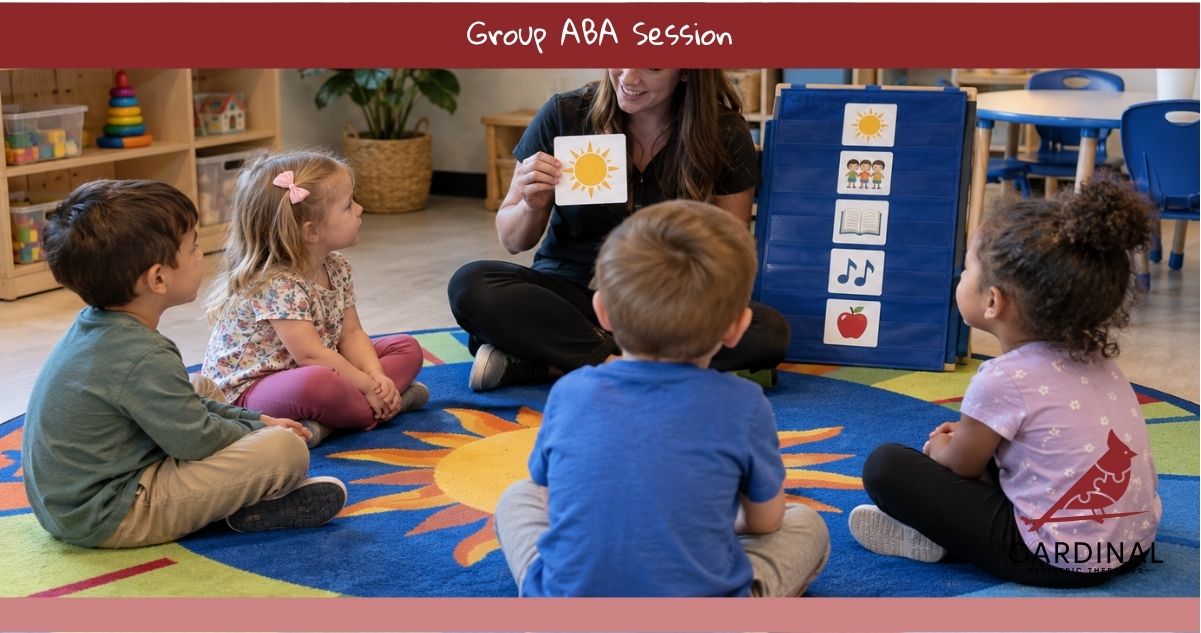
Reinforcement schedule work like this is built directly into Cardinal’s Classroom Readiness program, which runs sessions structured like an actual school day: group instruction, transitions, and shared attention specifically so a child’s reinforcement schedule gets tested and adjusted in something closer to the environment they’re actually heading into, rather than staying dense in a 1:1 setting until the first day of school arrives.
If you’re looking for a more general explanation of what positive reinforcement is and how it works, including some of the common myths around reward-based teaching, our guide on the benefits of positive reinforcement in ABA therapy covers that ground in more depth.
Ready to Prepare Your Child’s Reinforcement Plan for School?
Every child’s reinforcement schedule needs a different pace of thinning, and getting it wrong in either direction too fast or too slow can undermine skills that otherwise looked solid in therapy. Our BCBAs build that plan specifically around each child’s classroom-readiness goals.
Contact our team to talk through what a reinforcement plan for the classroom could look like for your child.
What is positive reinforcement in ABA therapy?
Positive reinforcement means a child receives something motivating immediately after a target behavior, which makes that behavior most likely to happen again.
How is positive reinforcement used to prepare a child for the classroom?
Reinforcement schedules gradually shift from immediate and frequent to more delayed and intermittent, mirroring what an actual classroom can realistically provide. This shift, often practiced through token economies, will help a skill hold up once a child no longer has 1:1 immediate reinforcement available.
What is a token economy and how is it used in ABA?
A token economy is a system where a child earns tokens for target behaviors and exchanges them for a reward once enough are collected. This is very different for each classroom-readiness goals, tokens are often tied to specific school-day skills like sitting through circle time or waiting for a turn.
Will a child become dependent on rewards from positive reinforcement?
The goal of reinforcement is actually the opposite: schedules are deliberately thinned over time so a skill becomes self-sustaining rather than reliant on constant rewards. Our guide on the benefits of positive reinforcement covers this and other common misconceptions in more depth.
How does reinforcement change once a child starts school?
Reinforcement in a classroom is naturally less frequent, less immediate, and shared across many students rather than individualized.
If your child’s individual ABA therapy is going well and someone has mentioned moving them into a classroom readiness program next, you’re probably wondering what that actually means in practice.
In this article, Alice Okamoto, MA, BCBA, LBA and Chief of Staff at Cardinal Pediatric Therapies, explains what a classroom readiness program really is, how it’s different from the one-on-one therapy your child may already be doing, what a child needs to be ready for it, and what “ready for school” actually means once you get past the buzzword.
How a Classroom Readiness Program Is Different from Individual ABA Therapy
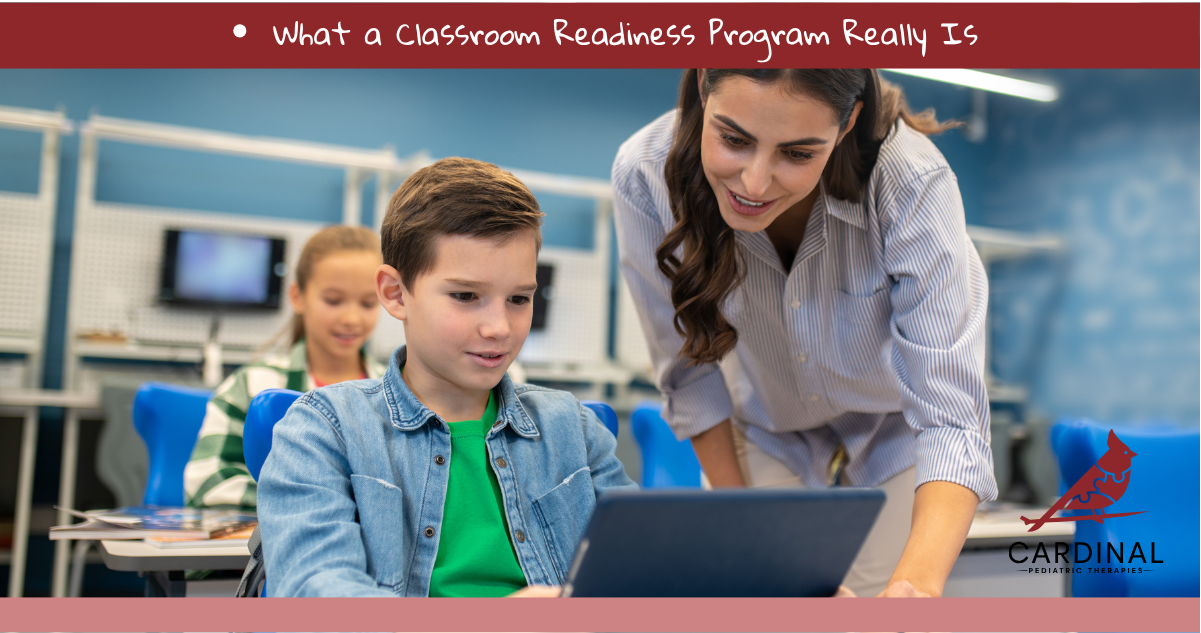
Individual ABA therapy is one-on-one, built entirely around your child’s specific goals, at your child’s own pace. A classroom readiness program is a different setup entirely, and it’s built to look and feel like an actual classroom.
“It’s a group setting, up to ten kids, and it’s specifically built to mirror what a real classroom looks like,” Alice explains. “We’re not just teaching a skill in isolation anymore, we’re teaching a child to use that skill while sitting with peers, following a group instruction, waiting their turn.”
In other words, the skill itself isn’t new, it’s the environment around it that changes. For more on how skills like this get taught in a classroom setting more broadly, our article on applied behavior analysis in the classroom is a helpful companion read.
What a Session Actually Looks Like
Sessions run nine to three, five days a week, in clinic, structured a lot like an actual school day on purpose: circle time, group instruction, transitions between activities.
Depending on where your child is at, they’ll be supported in one of a few ways:
Level of support
What it looks like
Independent
Your child participates in the group on their own
RBT-supervised group
A Registered Behavior Technician oversees the group, stepping in as needed
One-on-one with an RBT
An RBT works directly alongside your child within the group setting
“Depending on the outcome of ongoing assessment, we decide if a child can participate independently, with an RBT supervising the group, or one-on-one with an RBT right there,” Alice says.
Parents get a monthly report on how things are going, along with specific tips for reinforcing the same skills at home, many of which build on the same positive reinforcement techniques your child is already used to in individual sessions.
Not sure which level of support your child would need, or whether they’re close to ready? That’s exactly the kind of question a quick conversation can answer, no guesswork required. Reach out here and we’ll walk through it together.
What a Child Needs Before Joining
Not every child is ready for a group setting right away, and that’s normal, not a setback.
A few things we look for before recommending the classroom readiness program specifically:
Effective, independent communication. Your child can get their wants and needs across without heavy support.
Initiating play with peers. Independently, or with only minimal prompting.
Following two to three step instructions. Group settings move fast, and this is what keeps a child following along.
Limited unwanted behaviors. In a group of ten, safety and flow matter for everyone.
“If a child isn’t quite there yet, that’s not a no,” Alice says. “That just means individual or group ABA therapy is the right starting point first.” The program is a bridge, not a gate. Kids build toward it.
How Long Kids Typically Stay in the Program
There isn’t a fixed number we hand out, and honestly, a fixed number wouldn’t be honest.
Every plan takes into account your child’s individual and functional needs, their age, their specific goals, and the actual classroom setting they’re transitioning into.
Some kids move through the program faster because the remaining gaps are small. Others need more time, often around things like tolerating group expectations or handling transitions without one-on-one support. The transition itself is always the goal. The path to it just looks different for every child.
What “Ready for School” Actually Means
This is where most parents’ assumptions and reality split.
“I think the biggest one is thinking readiness is just about letters and numbers, academics,” Alice says. “It’s not, or at least that’s not the main thing.” A child can know their ABCs and still struggle badly in a classroom if they can’t handle a transition, wait their turn, or recover when something doesn’t go as planned.
Readiness, in practice, is really about:
Functioning inside a group instead of one-on-one
Following instructions the first time, without repeated prompting
Communicating needs without escalating
Recovering when something unexpected happens
Those are the things that actually determine whether the first weeks of school go smoothly, far more than whether a child can count to twenty.
Classroom Readiness at Cardinal Pediatric Therapies
Most parents who ask us about this have already heard the term “classroom readiness” somewhere and assumed it meant academic tutoring. It doesn’t. What we’re actually building is a child’s ability to function inside a group the way a classroom demands it, communication, transitions, following along, recovering from a hard moment, before they’re doing it in an actual kindergarten with thirty kids and no BCBA in the room.
It’s a private-pay program, not billed through insurance, and every plan is built around your child’s individual needs, age, and the classroom setting they’re heading into. If you’re earlier in the process and want general background on autism and early intervention, the CDC’s overview of autism spectrum disorder is a good place to start.
Ask a BCBA: Classroom Readiness Programs
What is the actual difference between a classroom readiness program and regular one-on-one ABA therapy?
“Individual ABA is one-on-one, built around a specific child’s goals at their own pace. The classroom readiness program is a group setting, up to ten kids, built to mirror an actual classroom. It’s less about teaching a brand new skill and more about teaching a child to use skills they already have, in a group.”
What does a typical group session actually look like?
“It runs a lot like a real school day: on purpose, circle time, group instruction, transitions between activities. Depending on the child, they might be in the group independently, with an RBT supervising, or one-on-one with an RBT. Parents get a monthly report either way.”
What skills does a child need before they can join a group like this?
“They need to be an effective, independent communicator, able to initiate play with peers on their own or close to it, follow two- to three-step instructions, and have limited unwanted behaviors. If a child isn’t quite there, that’s not a no; it just means individual or group therapy is the right next step first.”
What do parents get wrong about what it means to be ready for school?
“That it’s about academics. It’s really not, or it’s not the main thing. A child can know their letters and numbers and still struggle in a classroom if they can’t handle transitions or wait their turn. Readiness is functioning in a group, following instructions, communicating without escalating, and recovering when something goes sideways.”
Frequently Asked Questions
What age is a classroom readiness program best for?
The program is best suited for preschool-aged children, particularly those who need additional support before entering or re-entering a traditional classroom. Readiness is based on specific skills rather than age alone, so a BCBA evaluates each child individually before recommending the program.
Is a classroom readiness program covered by insurance?
No. Classroom readiness programs are typically private-pay and not billed through insurance, unlike individual ABA therapy sessions. Families should confirm current costs and payment options directly with the provider, since this can vary and isn’t something a general article can price accurately.
How is a classroom readiness program different from preschool?
A classroom readiness program is a clinical, BCBA-guided setting focused specifically on the behavioral and communication skills a classroom requires, with data tracked on each child’s progress. Preschool is the educational environment the program is designed to prepare a child for.
Does a child need a diagnosis to join a classroom readiness program?
Programs like this are typically designed for children already receiving ABA services, often with an autism diagnosis, since eligibility is based on skills developed through prior individual or group therapy. A BCBA can confirm whether a specific child qualifies.
What is the biggest misconception parents have about classroom readiness?
That it’s mainly about academics. As Alice explains it, a child can know their letters and numbers and still struggle in a classroom without the ability to handle transitions, wait their turn, or recover when something unexpected happens. That’s what readiness actually measures.
You’ve decided on in-home ABA therapy, your first session is coming up, and now you’re wondering what you actually need to do before the therapist arrives.
The honest answer is less than you think. In this article, Alice Okamoto, MA, BCBA, LBA and Chief of Staff at Cardinal Pediatric Therapies, walks through what genuinely matters to prepare your home for ABA therapy sessions, what depends on your child’s specific goals, and what you can stop worrying about entirely.
Start With Your Child’s Actual Goals, Not a Generic Checklist
Here’s the thing: most prep lists get it backward: what your home needs depends entirely on what your child is working on, not on a one-size-fits-all setup.
A child working on tolerating a busy environment doesn’t need a hushed, distraction-free room; they need the opposite. A child working on early communication skills at snack time needs a kitchen that’s usable, not staged.
“ABA goals are designed based on each child and their needs to communicate and function within their daily life, so that means right now,” Alice says. Your home doesn’t need to become a clinic. It needs to stay your home recognizably, because that’s where the skills have to work.
What Actually Helps: A Short, Real List
You don’t need a project plan. You need a handful of things sorted before the first visit.
One low-distraction spot. Not the whole house, just somewhere the therapist can go for goals that genuinely need focus, like a corner of a room with the TV off.
Know where your child’s favorites live. Preferred toys, snacks, anything your child is motivated by. These are the therapist’s tools on day one.
A few minutes to introduce the idea to your child. A photo, a name, a simple explanation of who’s coming and why. Familiarity lowers anxiety before the therapist even walks in.
A plan for siblings, not an absence of them. More on this below, but siblings do not need to disappear during sessions.
Nothing rearranged for appearances. Skip the deep clean. Skip buying new toys. The therapist needs your real home, not a staged one.
That’s genuinely the list. If you’ve done those five things, you’re ready.
What to Tell Siblings and Other Family Members
Siblings do not need to leave, and in many cases, they shouldn’t. A brother or sister walking through, a pet barking at the door, someone else’s normal noise: that’s the environment your child actually lives in, and part of what in-home ABA therapy is built to handle.
Sometimes a sibling becomes part of a goal directly: practicing turn-taking or sharing with a real peer instead of a hypothetical one. What helps most is a short, simple explanation for siblings ahead of time: someone is coming to help their brother or sister learn some new things, and it’s okay if they see it happen. You do not need a formal talk. A sentence or two is enough.
Not sure whether your specific setup or your other kids’ schedules will work with in-home sessions? That’s a conversation, not a hurdle. Reach out here, and we’ll walk through it together.
Sensory Setup: What Matters and What Doesn’t
Some environmental details genuinely help, and they’re smaller than people expect.
Helps
Doesn’t matter
Reducing background noise during focus-heavy tasks
New toys or supplies bought specifically for sessions
A consistent, predictable spot for goals that need it
A perfectly tidy house
Letting the therapist see real daily chaos for naturalistic goals
Rearranging furniture or decor
The pattern underneath all of it: the therapist is there to work with your actual life, not an idealized version of it. Over-preparing can actually work against certain goals, since some of what’s being taught is how your child handles the environment exactly as it already is.
What Happens If Something Isn’t Set Up “Right”
Nothing happens, honestly. If something about the environment would genuinely help a specific goal, your therapist will tell you directly and simply, not leave you guessing beforehand. This is true from the very first visit, which is covered in more depth in our article on what to expect from in-home ABA therapy: the early sessions are about building trust and comfort first, not running a tightly controlled environment.
If a change would help, it’s usually small. A specific spot cleared for one type of task. A snack kept in reach. Nothing that requires advance planning or money spent.
Preparing for Your First In-Home ABA Session at Cardinal
Most families spend more time worrying about home prep than the actual prep requires. We hear it constantly during intake: “Is my house going to be good enough? Do we need to buy anything? What if my kids won’t stay out of the way?”
What we walk every family through before that first visit is simple: know your child’s favorites, clear one low-distraction spot, give siblings a heads-up, and let the rest go.
Your BCBA builds the treatment plan around your actual home and your actual routines, not the other way around. If you’re getting ready for your first in-home ABA therapy session and want to talk through what your household specifically needs, get in touch with us here, and we’ll walk you through it before day one.
Ask a BCBA: Preparing Your Home for ABA Therapy
A family has decided on in-home ABA and their first session is coming up. What do they actually need to do before the therapist arrives?
Honestly, not much. Know where the favorite toys and snacks are, have one spot without a lot going on for the tasks that need focus, and give the child a heads up that someone new is coming. That’s really it.
What do families overprepare for that they don’t need to worry about?
Buying new toys, deep cleaning, trying to make the house look a certain way. None of that matters. We need to see the real home and the real routine, because that’s what we’re building the plan around.
Does the setup change depending on what goals the child is working on?
Completely. A child working on tolerating a busy environment doesn’t need a quiet room; they need the normal household noise. A child working on communication at snack time needs the kitchen to be usable, not staged. There’s no one setup that fits every goal.
What would you tell a parent who is anxious about getting it wrong before the first session?
You’re not going to get it wrong. If something in the environment would genuinely help, we’ll tell you directly, and it’s usually something small. Nothing about this needs to be perfect, and nothing needs to happen before we tell you it would help.
Frequently Asked Questions
Do I need a dedicated therapy room for in-home ABA sessions?
No. A dedicated room isn’t required. What helps is having one lower-distraction spot available for tasks that need focus, but sessions happen throughout the home depending on the goal, including the kitchen, living room, or wherever the skill needs to be practiced.
Should siblings be present during ABA therapy sessions at home?
Siblings don’t need to leave. Everyday household noise and activity is part of the environment therapy is designed to work within. Sometimes siblings are included directly in a goal, like turn-taking, and a brief explanation beforehand is usually all that’s needed.
Do I need to buy special toys or materials before starting ABA therapy?
No. Therapists use your child’s existing favorite toys, snacks, and activities as motivators because they already work. Buying new materials isn’t necessary and can actually be less effective than items your child is already drawn to.
How much notice does my child need before the first ABA session?
A short, simple explanation a few minutes or a day ahead is usually enough: who’s coming, and that they’re there to help. A photo or name introduced beforehand can lower first-session anxiety, but no extensive preparation is required.
What is the one thing that actually matters most when preparing for in-home ABA?
Knowing your child’s goals, not staging your house. As Alice explains it, setup depends entirely on what a child is working on, since a goal built around tolerating noise requires the opposite environment from one built around focus.
When people hear “aba parent training,” they usually picture a class, something separate from actual therapy, homework on top of everything else. That’s not quite it.
In this article, Alice Okamoto, MA, BCBA, LBA, and Chief of Staff at Cardinal Pediatric Therapies, explains what parent training really looks like woven into your child’s in-home ABA therapy sessions, what we actually expect from you week to week, and what tends to shift for families once it clicks.
Parent Training Isn’t a Separate Class. It’s Built Into the Sessions.
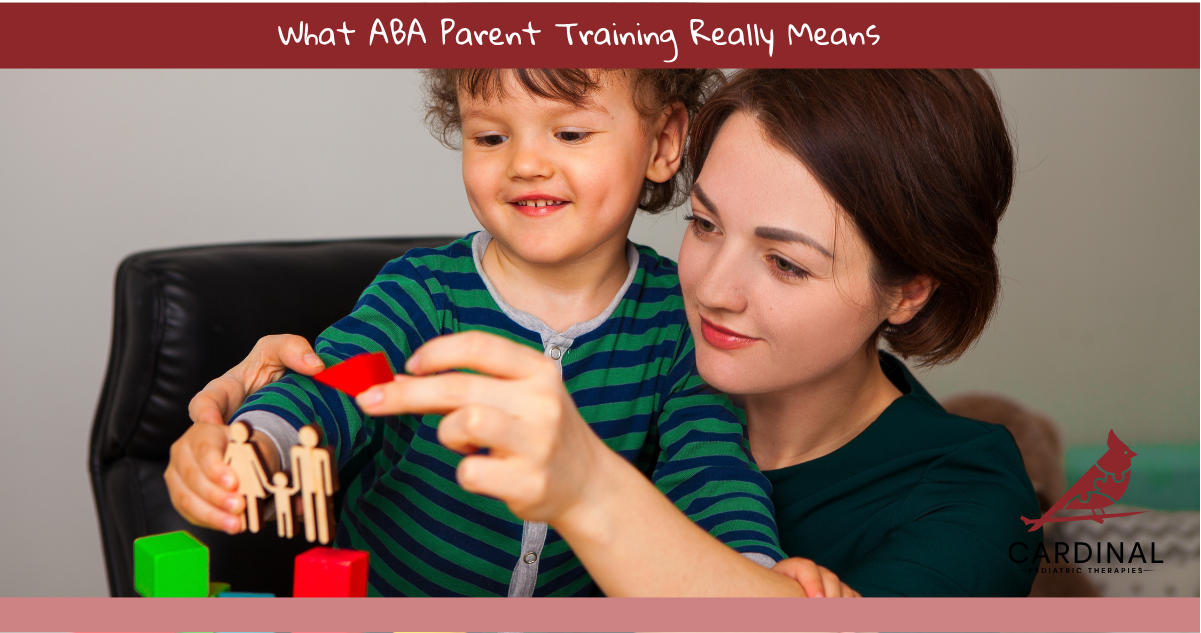
Here’s the distinction that surprises most families: this isn’t a workshop you attend once and check off. It’s happening in the room, during the same sessions your child is already having.
While the RBT works with your child, part of what’s happening is you learning, in real time, why a certain approach works and how to keep it going after the session ends.
“We know that pairing, building meaningful rapport, is essential to successful therapy, and it’s important that parents can trust that that process is effective,” Alice says. That trust runs both directions. You need to trust the process, and we need you to be fluent enough in it to carry it forward.
For families who want something more structured on top of that, Cardinal also runs a dedicated ABA parent coaching program, sessions that can run 30 minutes a week or once a month depending on what your family needs. But that’s the add-on.
What we’re talking about here is the training that happens automatically, just by having in-home ABA therapy in your house.
What We’re Actually Asking You to Do
Not as much as you’re probably picturing, and not nothing either. It depends on the goal.
What’s happening
What training looks like for you
A skill tied to a daily routine, meals, dressing, transitions
You’re shown the exact technique in the moment, then you practice it yourself with the therapist coaching you
A newer or harder goal
You watch first, ask questions, then start practicing pieces of it as your child gets more comfortable
Between sessions
Simple, specific things to keep doing, not a homework packet
Program review
A conversation with the BCBA about how the plan is going and whether it needs adjusting
“Parents should also ask about program modification and how their child’s behavior analyst determines the need for treatment adjustment, as well as parent collaboration and parent training,” Alice says. That’s not a script we hand out. It’s a genuine back-and-forth that changes as your child does.
Wondering what this would actually look like for your specific family and your specific child? That’s exactly what the first conversation is for: start here.
What Parents Get Wrong at First
The most common thing we hear, almost word for word, is some version of “I’m not a therapist, I’m going to mess this up.”
You won’t. Nobody is asking you to run a session or diagnose why a strategy isn’t landing. What we’re asking is much smaller: notice the moment, use the phrase or prompt we showed you, and stay consistent with it. Consistency is the actual job. Perfection was never the assignment.
The other thing families get wrong is thinking training means adding something extra to an already full day. It doesn’t. The goal is to fold a technique into something you’re already doing anyway: bath time, the car ride, or getting shoes on. You’re not creating new time. You’re changing what happens in the time you already have.
What Changes By the End of the First Month
This is usually where it clicks.
By four weeks in, most parents aren’t thinking about the technique anymore; they’re just doing it, the way you stop thinking about a new habit once it’s actually a habit. A phrase that used to feel awkward to say out loud starts coming out naturally. You start catching moments to use it before the therapist even points them out.
And the difference shows up in the data. Kids whose families are actively part of the process tend to generalize skills faster, meaning the skill shows up not just in session, but at dinner, at the grocery store, at grandma’s house.
That’s the entire point of doing this in-home instead of in a clinic in the first place.
In-Home Parent Training at Cardinal Pediatric Therapies
Most parents call us thinking their two options are sit in the corner or become a co-therapist. Neither is right. What actually happens is something in between, built specifically around your family, not a generic script.
Every session doubles as training, because you’re in the home, in the real routine, watching and eventually doing the thing your child needs.
On top of that, families who want a more formal structure can add our dedicated ABA parent coaching program.
And if you’re still working out whether in-home ABA therapy in general is the right fit before you get to any of this, our article on what to expect from in-home ABA therapy walks through the first 90 days from the very beginning.
Ask a BCBA: Parent Training in In-Home ABA Therapy
When families first hear the words “parent training,” what do they usually think it means, and how is the reality different?
Honestly, most parents picture a class or a worksheet, something separate from therapy. The reality is it’s happening during the actual sessions. You’re learning right there in the room, in real time, not sitting down afterward to study something.
Many parents feel guilty about not being able to do what a trained therapist does. How do you handle that?
I tell them straight up, nobody’s expecting that. We’re not handing you a treatment plan to run on your own. We’re asking you to be consistent with one or two specific things, and that’s genuinely enough. The guilt usually comes from parents assuming the bar is higher than it actually is.
What do parents get wrong most often when they try to carry skills into daily routines on their own?
Trying to add something new instead of folding it into what’s already happening. It’s not extra time you have to find. It’s changing what you do during the time you already have—bath time, the car, getting shoes on.
What does it look like when a family really commits to the training? What changes for the child?
Skills hold up outside of session. That’s the real marker. A child using a new way to communicate not just with the therapist, but with a sibling, at the grocery store, at grandma’s. That’s generalization, and it happens faster when the family is actually part of it.
Frequently Asked Questions
What does ABA parent training actually involve day to day?
It’s built into your child’s regular in-home sessions rather than being a separate class. You watch the therapist use a technique, then practice it yourself with coaching, focused on one or two specific things to stay consistent with between visits, not a full curriculum.
Is ABA parent training required, or optional?
Some level of parent involvement is expected, since skills need to transfer from sessions into daily life to stick. How involved you are depends on the goal. Families who want more structured coaching on top of that can add Cardinal’s dedicated parent coaching program.
How much time does parent training add to my week?
Very little, by design. Training happens during sessions you’re already having, and the follow-through usually means folding one technique into a routine you’re already doing, like mealtime or the car ride, rather than a separate block of homework.
Do I need any special training or background to do this?
No. You’re not expected to function as a therapist. The behavior analyst and RBT teach you concrete, specific things to do at specific moments. What matters most is consistency, not clinical skill.
What actually changes for families who fully commit to parent training?
Skills start to generalize beyond the session, showing up with siblings, at the store, andat a grandparent’s house. As Alice puts it, that’s the real marker of progress, and kids whose families stay consistently involved tend to get there faster.
If you’re weighing in-home ABA therapy for your child, you probably have one honest question underneath all the research: what actually happens when a stranger comes into our house to work with my kid?
In this article, Alice Okamoto, MA, BCBA, LBA and Chief of Staff at Cardinal Pediatric Therapies, walks through the real version, not the brochure version, of what the first visit looks like, what your role is, and how you’ll actually know it’s working by the time you get to day 90.
The First Visit Is Not What You’re Picturing
Most parents brace for something clinical. A binder, a checklist, a stranger directing your child through tasks while you hover nearby wondering if you’re doing this right.
That’s not what a good first session looks like, and if it did, something would be off.
The early weeks of in-home ABA therapy are built around what therapists call pairing, and it’s basically exactly what it sounds like: your child and their therapist becoming people who trust each other.
“Pairing is building a safe and trusting relationship for the child with their therapist,” Alice says. “It’s essential throughout the entire therapy process, but extra essential in the beginning to be successful.”
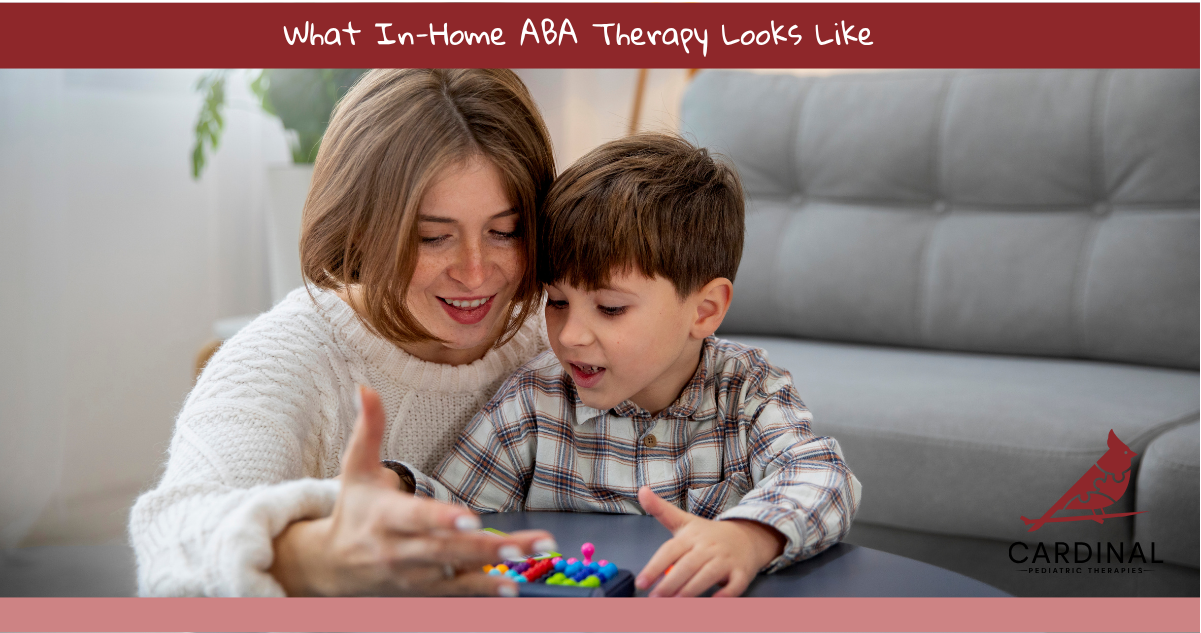
So the therapist gets on the floor. They play with whatever your child already loves. They follow your child’s lead instead of the other way around. To an outsider, it might look like nothing structured is happening.
What’s actually happening is the only thing that makes everything after it possible.
Setting Goals Around Your Actual Life, Not a Generic Plan
Before regular sessions start, a Board Certified Behavior Analyst comes to do an assessment, usually one to two hours, in your home, along with a conversation with you. From there, they write your child’s treatment plan, and everyone in the family reviews and signs off before it goes to insurance.
Here’s what makes doing this in your home different from doing it in a clinic: nothing has to be guessed at.
The BCBA sees where dinner actually falls apart. Which transitions send your child into a spiral. How your child asks, or doesn’t ask, for what they want, in the kitchen where it actually happens. Goals get built from that, not from a template.
“We always want to assess and start with skills that replace harmful behaviors, whether that be self-injury, aggression, elopement, and communication in general,” Alice says. “These usually work hand in hand.”
If a child has figured out that hitting himself gets mom’s attention fast, the plan teaches him a faster, safer way to get that same attention. Once he has it, he usually no longer needs the old way.
Your Role: More Involved Than You’d Think, Less Than You Fear
You will not be asked to leave your own house. You’re also not expected to run the session like a co-therapist. What you’re asked to do shifts depending on the goal.
Be in it with us. These are the moments you’ll be handling once we’re not there
A new skill your child handles differently around you
Stay nearby but hang back. Some kids act completely different with mom or dad in the room, and that’s normal, not a problem
End of session
A few minutes talking through what happened and what to try before we’re back
Formal parent training
Scheduled time built specifically around your family’s routines
That last row is worth pausing on, because it’s not a nice-to-have. Parent involvement is a big part of why in-home ABA therapy works at all, since the skills your child learns have to survive after the therapist’s car pulls out of the driveway. This is exactly what our ABA parent coaching program is built to teach on purpose, at whatever pace fits your family.
Not sure where you’d land on that table, or what your child’s specific plan would even look like? That’s what the first call is for, and it costs you nothing but a conversation: start here.
Your House Is Loud. That’s Fine. That’s the Point.
Real homes have siblings barreling through the room, dogs barking at the mail carrier, a TV nobody remembered to turn off. We don’t work around that. We work with it.
Learning to hold onto a new skill while all of that is happening is the actual goal, not a distraction from it. Sometimes a sibling even gets pulled directly into a session to practice sharing or taking turns, because that’s a real skill practiced on a real person your child actually knows.
And no, your house does not need to be spotless or specially arranged before we arrive. If something small would genuinely help, the therapist will just tell you.
What Progress Looks Like at 30 Days, and What It Looks Like at 90
This is where expectations go sideways for a lot of families, so let’s set them honestly.
The first 30 days
You’re not looking for big skill wins yet. You’re looking for your child being comfortable, maybe even a little excited, when the therapist shows up. Staying close. Sessions starting to feel less new.
“We don’t usually expect the first several weeks to be easy or necessarily show lots of progress with goals, and that’s okay,” Alice says. “Children are still warming up to their therapist and to their therapy in general. Great things do take time.”
Day 60 through 90
This is when you’ll actually start to see it: your child responding to instruction more readily, communicating in ways they hadn’t before, tolerating things that used to end in a meltdown.
How you’ll actually know, instead of just hoping
Every single session, the therapist is taking data on your child’s specific goals. What’s working, what isn’t, what needs to change, all of it gets reviewed by the behavior analyst with your family. You don’t have to take our word for whether in-home ABA therapy is working. Your child’s own data tells you.
In-Home ABA Therapy at Cardinal Pediatric Therapies
Most families who call us have already read every general explainer online and still can’t picture what a Tuesday afternoon in their own living room would look like.
That picture only comes from the intake process itself: after paperwork and insurance approval, a BCBA runs the in-home assessment, writes a plan around your family’s actual priorities, and a Registered Behavior Technician runs sessions under that BCBA’s supervision, in the rooms where your child’s hardest moments really happen.
We provide in-home ABA therapy across North Carolina, including Cary, Raleigh, Clayton, Winston-Salem, Greensboro, and Wilmington, and across the greater Phoenix area in Arizona, including Mesa, Gilbert, Chandler, Scottsdale, and Glendale.
Sessions can move beyond the house too, into daycare, school, or the community, wherever your child needs the support to show up. Most families move from that first call to their first session within three to four weeks, primarily due to the assessment and insurance processes.
Ask a BCBA: In-Home ABA Therapy
A therapist is coming to our house for the first time. What actually happens when you walk in the door?
The first thing we focus on is pairing, so it’s going to look like play. We’re getting on the floor, following what the child already likes, not walking in with a checklist. Some parents expect it to look more formal, and I get that, but that relationship is what everything else gets built on.
Should I be involved during sessions, or stay out of the way?
It depends on the goal, honestly. For daily routine stuff, meals, getting dressed, we want the parent right there, because that’s what you’ll be running once we’re not in the home. For other goals, we’ll ask you to hang back a little, because some kids act really differently with a parent in the room. Neither one means you’re doing it wrong.
What surprises parents most once in-home sessions start?
How much of it is play, honestly. People picture a table and worksheets, and sometimes we do use a table if the task needs it, but a lot of the work is naturalistic, so it’s happening at snack time, during transitions, getting shoes on. The data collection surprises people too; we’re tracking constantly, every session.
What does progress look like in the first 30 days, and how do we actually know it’s working?
In the first 30 days, we’re mostly looking at the relationship: is the child comfortable, are they engaging, are sessions getting smoother? By 60 to 90 days, we want to see greater responsiveness to instruction, new communication, and greater tolerance for hard tasks. And we’re not asking parents to just trust us on that. We’re taking data every session, and the behavior analyst goes over it with the family. That’s how you know.
Frequently Asked Questions
How long are in-home ABA therapy sessions?
Session length follows your child’s treatment plan and the hours a BCBA recommends clinically, not a fixed template. Sessions commonly run two to four hours, scheduled around your family’s availability. Total weekly hours are set after the initial in-home assessment.
Do parents need to be home during in-home ABA sessions?
A parent or responsible adult needs to be present in the home. That doesn’t mean sitting through the whole session. Depending on the goal, your therapist may want you actively involved or nearby and hands-off, and they’ll tell you which, session by session.
Who actually runs in-home ABA sessions?
A Registered Behavior Technician, or RBT, works one-on-one with your child during sessions. Everything they do follows a treatment plan written and supervised by a Board Certified Behavior Analyst, who reviews session data and adjusts the plan as your child progresses.
How many hours a week is in-home ABA therapy?
It depends entirely on your child. A BCBA recommends hours based on clinical need identified in the assessment, then works with your family on a realistic schedule. Getting as close as possible to that recommendation matters, since it’s a medical recommendation, not a suggestion.
What is pairing in ABA therapy?
Pairing is the process of building a safe, trusting relationship between your child and their therapist, and it’s the real work of the first few weeks. As Alice puts it, pairing matters throughout therapy but is extra essential at the start. A child who trusts their therapist learns faster.
When a child has autism, connecting with peers can feel confusing or painful. Play dates stall, group activities end in tears, and parents start to worry that friendships may never come easily.
Social skills develop over time, and many kids need more than “just exposure” to learn how to join in. Structured social skills training autism programs give children clear coaching and lots of practice, so relationships feel safer and more predictable.
At Cardinal Pediatric Therapies, ABA therapists design social goals that match each child’s age, personality, and learning style for families in Cary, Phoenix, Wilmington, Clayton, and nearby communities.
Why social skills feel hard for many autistic children
Autism affects how children read cues, process language, and understand what other people expect. That often shows up during play and group time.
Many families notice that their child:
Prefers to play alone or repeats favorite activities instead of joining others
Wants friends but “freezes” or uses scripts that do not fit the moment
Struggles with turn taking, sharing, or waiting
Misreads facial expressions, tone of voice, or personal space
The University of Kansas highlights how social communication differences can limit participation in class, clubs, and community activities in its overview on autism communication.
Autism social development is not about changing who a child is. Social training for autism focuses on giving kids tools so they can:
Express what they want and need
Understand others more clearly
Feel more confident around peers
What social skills training autism programs focus on
Research on social skills training autism programs shows that structured teaching can improve how children engage, problem solve, and maintain friendships.
Most programs target skill areas such as:
Joining play and staying with a group
Greetings, eye contact, and body language at a level that feels comfortable
Conversation turn taking and topic changes
Handling teasing, misunderstandings, or mistakes
Managing big feelings during social situations
AFIRM describes social skills interventions as step by step teaching that includes modeling, role play, and real world practice.
Cardinal’s dedicated Social Skills Training services build these abilities through play, modeling, and guided interaction that fit each child’s developmental stage.
How ABA therapy structures social training for autism
In ABA, ABA therapy social skills goals sit inside a larger plan for communication, behavior, and independence. Board Certified Behavior Analysts break social goals into small, teachable steps, then track progress over time.
Social skills training usually happens in two main formats:
One to one sessions that introduce new skills
Group social skills autism sessions that allow practice with peers
The In-Clinic ABA Therapy environment gives children a structured, supportive space for this kind of practice.
One to one ABA: building foundations for interaction
In individual sessions, therapists slow social situations down so children can understand and rehearse them.
Sessions might include:
Practicing simple greetings with a therapist
Using visual supports to plan out a play routine
Role playing what to say when a peer takes a turn or suggests a new game
Using reinforcement to celebrate every step toward interaction
The Parent Guide to ABA Therapy at Cardinal explains how these individualized goals fit within a broader treatment plan and how parents can follow progress.
One to one work also leaves room for sensory breaks and coping strategies, which keeps social behavior therapy autism friendly and respectful of each child’s nervous system.
Group social skills autism sessions: practicing with peers
Once a child has some foundation skills, group work offers a safe place to try them with other kids.
ABA based groups often include:
Circle time with greetings and sharing
Cooperative games that require turn taking and problem solving
Guided conversation practice with clear visual supports
Feedback and specific praise that highlight what went well
Peer mediated models, where therapists coach peers to include and respond to autistic children, can further boost autism peer interaction support as described in resources from the Indiana Institute on Disability and Community.
Cardinal’s family and group offerings, described in the ABA group therapy overview, combine games, stories, and structured play so social training for autism feels fun, not forced.
Real life examples of skills targeted in social skills training
Parents often ask what “social skills” actually looks like in a session. In Cardinal’s programs, therapists work on everyday interaction, not polished scripts.
Common goals for improving social skills in autistic children include:
Play and cooperation
Sharing materials and taking turns
Joining a game that is already in progress
Accepting small changes in rules or routines
Conversation and connection
Starting a conversation with a peer
Staying on topic for a few turns
Asking simple follow up questions
Understanding others
Noticing basic facial expressions
Matching voice volume to the setting
Respecting personal space and boundaries
Social Stories also help children rehearse tricky situations, like asking to join a group or handling “no” from a peer, before they happen in real life, as described in Social Stories in ABA Therapy.
Bringing social skills into school and community
Families do not want skills that only show up in the therapy room. ABA teams plan for generalization so children can use new social tools at school, in the neighborhood, and during family activities.
Therapists often:
Coordinate with teachers and IEP teams
Share simple strategies that fit into the school day
Use classroom like activities during in clinic sessions
For older children and teens, social behavior therapy autism plans may include community outings like playground trips, library visits, or small group meetups, always with clear expectations and support.
How Cardinal tailors social goals for each child
No two children need the same path. Some may start with basic play skills, while others benefit from more advanced coaching on friendship, group projects, or emotional problem solving.
At Cardinal, BCBAs and therapists:
Complete a detailed assessment that includes parent input
Prioritize goals that matter to the family
Choose teaching strategies that fit the child’s strengths and sensitivities
Adjust the plan as skills grow using data and observation
Over time, social training for autism becomes less about drills and more about real connection, supported by adults who know when to step in and when to step back.
How parents can support social skills training autism work at home
Parents play a huge role in keeping social growth moving between sessions.
At home, parents can:
Model simple social phrases during daily routines
Set up short, low pressure play opportunities with one familiar child
Use visuals and Social Stories before stressful social events
Praise specific social efforts, such as “You waited for your turn”
The Parent Guide to ABA Therapy at Cardinal outlines practical ways to track gains and celebrate both small and big wins.
When parents, therapists, and schools pull in the same direction, social skills training autism programs can help children move from feeling left out to feeling included.
When to consider more structured social support
Many parents seek help when they notice that their child wants friends but interactions often end in tears.
You might also notice that your child is much quieter around peers than at home, or that playground and classroom comments sound confusing or rigid.
Reaching out earlier allows coaching to line up with important milestones like preschool, kindergarten, or middle school transitions.Through social skills training and integrated ABA services, Cardinal Pediatric Therapies uses evidence informed tools to support friendships, confidence, and everyday connection for autistic children and their families.
If your child has autism and uses very few words or no speech, communication can feel like a daily puzzle. You may see your child get upset throwing toys, or shut down and still feel unsure what they needed in that moment.
Augmentative communication for autism gives children extra ways to express themselves. These tools do not replace your child’s voice. They create more paths for connection at home, in school, and in the community. Families across North Carolina and Arizona work with Cardinal Pediatric Therapies to explore these options in a structured, supportive way.
What Is AAC?
Augmentative and alternative communication includes any way of communicating that does not rely on spoken words alone. According to the American Speech Language Hearing Association, AAC covers methods like signs, picture symbols, communication boards, and speech generating devices that support or replace speech for people of all ages who have trouble with speech or language.
For children with autism, AAC might involve:
Gestures and simple signs like “more,” “help,” and “all done”
Picture cards, photos, or symbol boards for favorite foods or toys
Tablet based communication apps that speak when your child taps icons
AAC can:
Add to spoken language when some words are present
Provide another option when speech feels very hard
Grow and change as your child learns new skills
For many autistic children, AAC becomes the bridge between wanting something and being able to share that need clearly.
Types of AAC Tools for Autistic Children
There is no single best AAC system. A strong plan uses alternative communication strategies for autism that match your child’s strengths, interests, and daily routines. Autism organizations describe AAC as a range from no tech strategies to high tech tools.
No-tech and low-tech AAC
Natural gestures and body language
Simple sign language for common words
Picture Exchange Communication System (PECS), where a child hands a picture to request something
Choice boards with pictures for snacks, toys, people, or activities
Mid-tech AAC
Recordable buttons with short, repeated messages
Small communication devices with a fixed set of symbols
High-tech AAC
Tablet based communication apps
Dedicated speech generating devices with more advanced language options
Many children start with low tech tools. As they grow, a team can add or switch to mid or high tech options if that better fits the child and family.
Why Augmentative Communication for Autism Matters in Daily Life
Many autistic children learn best through visual information. Pictures, symbols, and written words often feel easier than long strings of speech. Augmentative and alternative communication (AAC) builds on that strength and gives your child clear ways to share needs and ideas.
When your child has a reliable way to communicate, you often see:
Fewer meltdowns, because your child can say “stop,” “break,” or “different”
Less stress for parents, with less guessing about every want or need
More independence as your child asks for help and makes choices
Better participation in group activities, classroom lessons, and playdates
AAC can promote independence, expand communication, and increase social interaction for people with autism at many ages. Most importantly, it supports your child’s right to share feelings, opinions, and not just basic needs.
AAC creates the most change when a supportive team teaches it step by step.:
ABA therapy to break communication goals into small, clear steps
Speech therapy to build language, sound production, and functional communication
AAC tools that match your child’s learning style and daily environment
In clinic, your child may practice requesting favorite items, labeling people and objects, and using simple social phrases like “hi,” “bye,” and “my turn.” Many families also choose in home ABA therapy so their child can practice AAC during real routines like meals, bath time, and bedtime. Growing Language and Communication services add even more focused support for augmentative communication for autism.
AAC works best when it becomes part of normal life
Morning and evening: visual schedules and picture choices for clothes, hygiene, and bedtime stories
Meals and snacks: picture cards or device pages for “more,” “different,” “drink,” and “all done”
Play and outings: symbols for “again,” “help,” “my turn,” “stop,” and portable cards or a tablet for trips to the park or store
In home ABA gives families hands on coaching so these tools fit naturally into your child’s environment and daily rhythm.
Easing Common Worries About AAC
Many parents feel nervous the first time someone suggests AAC. You are not alone if you have questions or doubts.
“Will AAC stop my child from talking?”
Research on AAC and autism finds that these interventions can improve communication without blocking speech development. In many studies, AAC helped people with autism communicate more effectively and sometimes use more spoken language over time.
“Is my child too young for AAC?”
Professionals often encourage early support when children show significant communication delays. AAC can give young children a way to express needs and preferences while longer term language skills continue to grow. Parent focused AAC resources stress that families can start small and adjust tools as children change.
“What if my child just presses buttons for fun?”
Therapists at Cardinal set clear goals so devices and boards have meaning. Your child learns that tapping a symbol can start a game, bring a snack, or get your attention. That sense of power helps communication feel exciting, not random.
When to Consider an AAC Evaluation
Every child is different, but some patterns suggest that an AAC evaluation could help.
You may want to explore augmentative communication for autism if:
Your child is older than two and uses few or no meaningful words
Your child mainly communicates through crying, grabbing, or behavior
Teachers, relatives, or babysitters often say they cannot tell what your child wants
Your child seems to understand more than they can express
You can bring these concerns to your pediatrician, current ABA provider, or a speech language pathologist.
How Cardinal Pediatric Therapies Supports Communication Growth
Cardinal Pediatric Therapies offers autism communication support through a coordinated set of services:
In clinic ABA therapy with structured individual and group sessions that build social and communication skills
In home ABA therapy that works inside family routines and helps caregivers use AAC tools consistently
Speech therapy that focuses on language development, articulation, and effective use of AAC systems
Parent coaching and family support that help caregivers feel confident using communication strategies every day
Moving Forward with Confidence
If you feel unsure where to start, remember that exploring AAC does not lock your child into one device or method. It simply opens more doors.
You can begin by:
Asking your current providers how AAC might support your child
Reading parent friendly information from respected autism and communication organizations
Talking with Cardinal about evaluations, ABA therapy, speech therapy, and in home supports in your area
Augmentative communication for autism offers your child more ways to say “I am here” and “This is who I am.” With the right mix of tools, ABA therapy, speech support, and family involvement, your child can build a communication system that feels powerful and personal.
This article is for educational purposes only and does not replace medical, diagnostic, or therapeutic advice. Always consult qualified professionals about your child’s specific needs and treatment options.
Dr. Mike Henderson, Ph.D., BCBA-D, LBA
Regional Operations Director
North Carolina
Mike Henderson, PhD, LBA, BCBA-D, is the Regional Operations Director at Cardinal Pediatric Therapies. With over two decades of experience in behavior analysis and organizational leadership, he focuses on mentoring teams and fostering a culture of collaboration, growth, and excellence in client care. Mike believes strong leadership and supportive systems are essential for helping clients, families, and providers succeed together.
Felicia Freeman
Clinic Manager
I am Felicia Freeman, the Clinic Manager for Cardinal Pediatric Therapies. I have been in ABA for several years now and am passionate about the community that we serve. I started out as an RBT, decided to go the administrative route, and worked my way up to managing clinics. I choose this field every day because I enjoy making a meaningful impact in the lives of our clients and building strong teams that change lives.
Amanda Dean, MA, BCBA, LBA
Johnston County, NC
Amanda graduated from The Chicago School of Professional Psychology in 2018 with her Masters in Psychology. She proceeded to complete her graduate certificate in ABA and became a BCBA in November 2020. Amanda has a passion for behavior reduction, tolerance training and functional communication training. She enjoys spending as much time as she can with her 3 children and husband. When she’s not working, Amanda is very involved in her local Pop Warner Cheerleading program where she is the Assistant Cheer Director and a head coach.
Becky Fronheiser
Operations Director
Arizona
Becky has worked in behavioral health for 7 years. She joined Cardinal in the spring of 2024. Becky is grateful for the opportunity to work with such a passionate group of people and looks forward to supporting families with their specific ABA needs. In her personal time, she enjoys spending quality time with her husband, 6 kids and 4 grandkids and loves to travel and relax on the beach.
Matthew Wilkinson
Operations Director
Cary, NC
Matthew holds a bachelors degree from the University of Utah, Medical Degree from the Autonomous University of Guadalajara and an MBA from Western Governors University. He has worked in the pediatric field for the majority of his professional life and has a passion for helping bring the best care to children in need. He enjoys spending time with his wife and three children and day trips to the coast.
Trisha Iannotta Bieszczad, PsyD., BCBA
Triad, NC
Trisha is a Board Certified Behavior Analyst (BCBA) with extensive expertise since 2016 in applying behavior analytic principles to improve the lives of children and adolescents. Her professional journey began with a doctoral degree in clinical psychology, emphasizing child and adolescent development. This foundation has equipped her with a deep understanding of psychological theories and practices, which she seamlessly integrates into her work as a BCBA. Outside of her professional endeavors, Trisha enjoys reading, spending time outdoors with her family & trying out new restaurants. Trisha’s dedication to both her career and personal interests reflects her commitment to continual growth and enrichment, both professionally and personally. Her multifaceted background allows her to approach each aspect of her life with a blend of expertise, enthusiasm, and a genuine appreciation for learning and exploration.
Tina Lee
Director of Finance
Tina Lee is the Finance Director for Cardinal with a variety of experience in the Healthcare Industry for over 13 years. She is compassionate and always eager to assist where she can. In the ever-changing Healthcare environment, Tina has played a vital role in putting processes in place to obtain high efficiency outcomes to help our clients get the care they need. Tina enjoys the outdoors and loves spending time with her family.
William Evans
Director of Outreach and Recruitment
William is a UNCW Graduate who started his professional career working in Marketing and Recruiting for a local technology company before looking for an opportunity to take those skills and help others. In his spare time he plays hockey, including annually for the North Carolina Autism Hockey Tournament, which is dedicated to the raising money and awareness for organizations helping local families with children diagnosed with autism.
Alice Okamoto, MA, BCBA, LBA
Chief of Staff
Alice has been with Cardinal for over 4 years and has worn many hats along the way! Alice has a passion for working with clients and families as a unit, supervising behavior analyst trainees, and collaborating on strategic initiatives to ensure clinical efficiencies. Alice‘s professional experience began with ABA in a school setting, and has worked in schools, homes, and clinics throughout the years while enjoying collaboration with related providers. In her free time, Alice enjoys traveling, exploring parks with her dog, Oliver, and trying new restaurants.
Darrin Miller
CEO
Darrin has dedicated his education and career to the field of behavioral health. As a licensed therapist and master’s in clinical counseling he works to create solutions that improve the lives of those impacted by Autism Spectrum Disorder at a local, state, and national level. He strives to create a culture of caring and empathy while innovating solutions for improving families’ access to quality care as quickly as possible.