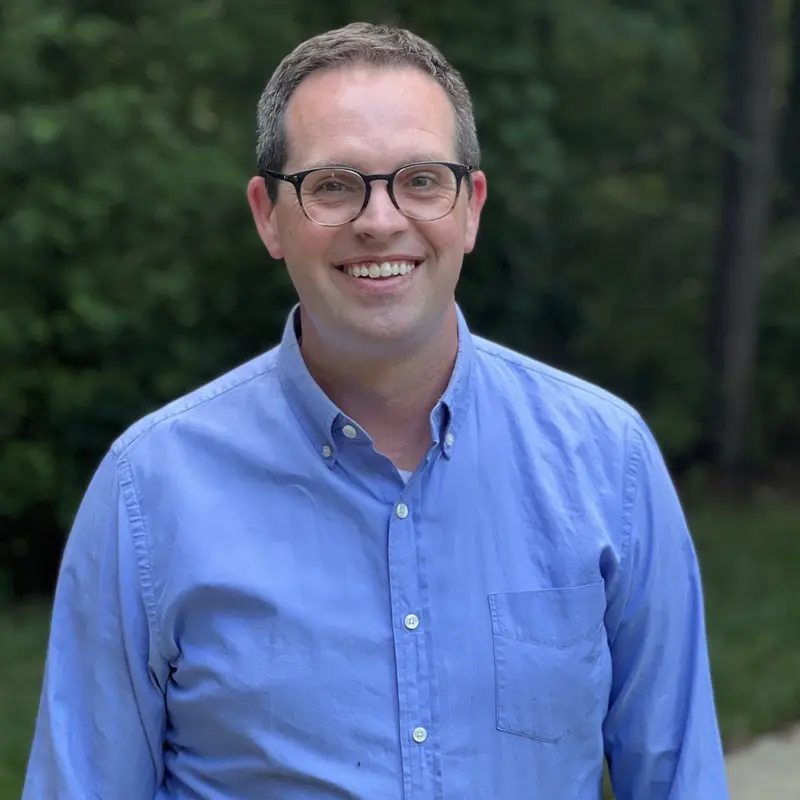
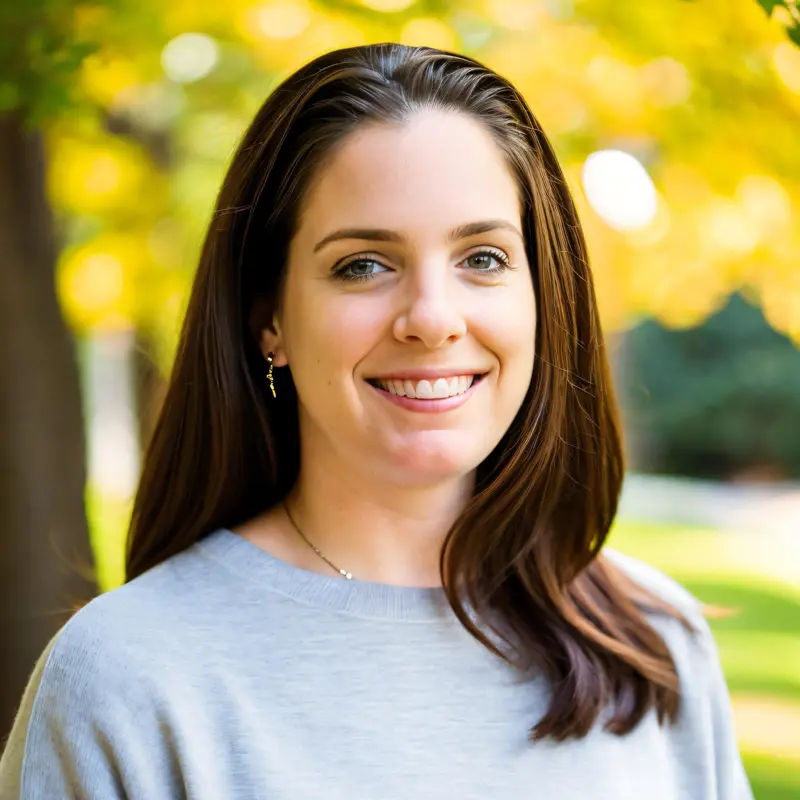
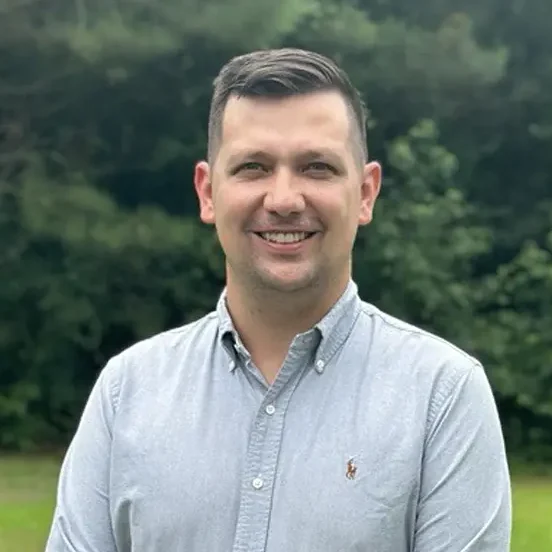
Regional Operations Director @ Cardinal Pediatric Therapies
Mike Henderson, PhD, LBA, BCBA-D, is the Regional Operations Director at Cardinal Pediatric Therapies. With over two decades of experience in behavior analysis and organizational leadership, he focuses on mentoring teams and fostering a culture of collaboration, growth, and excellence in client care.
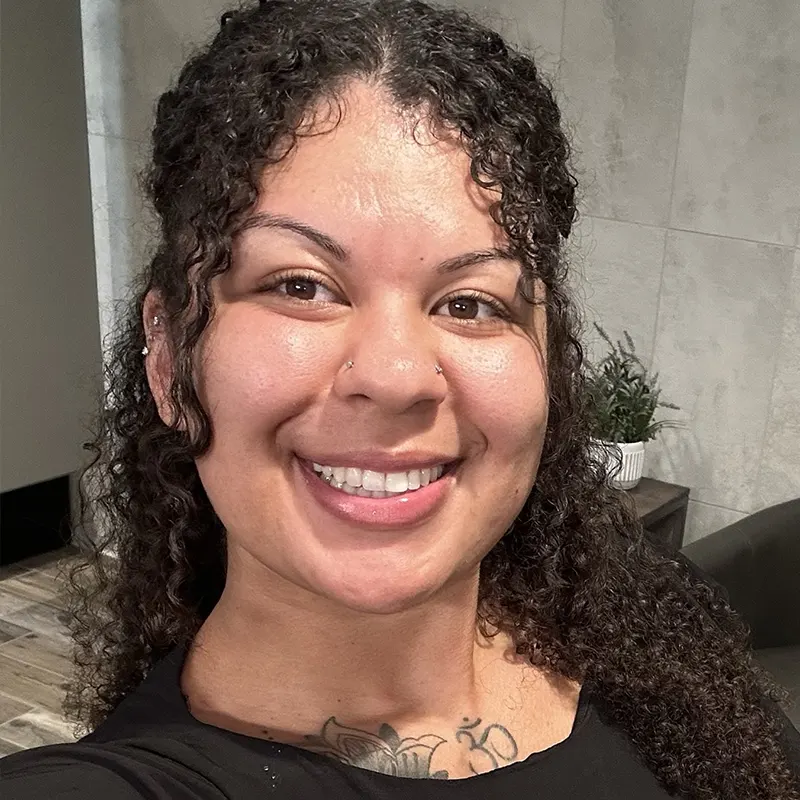
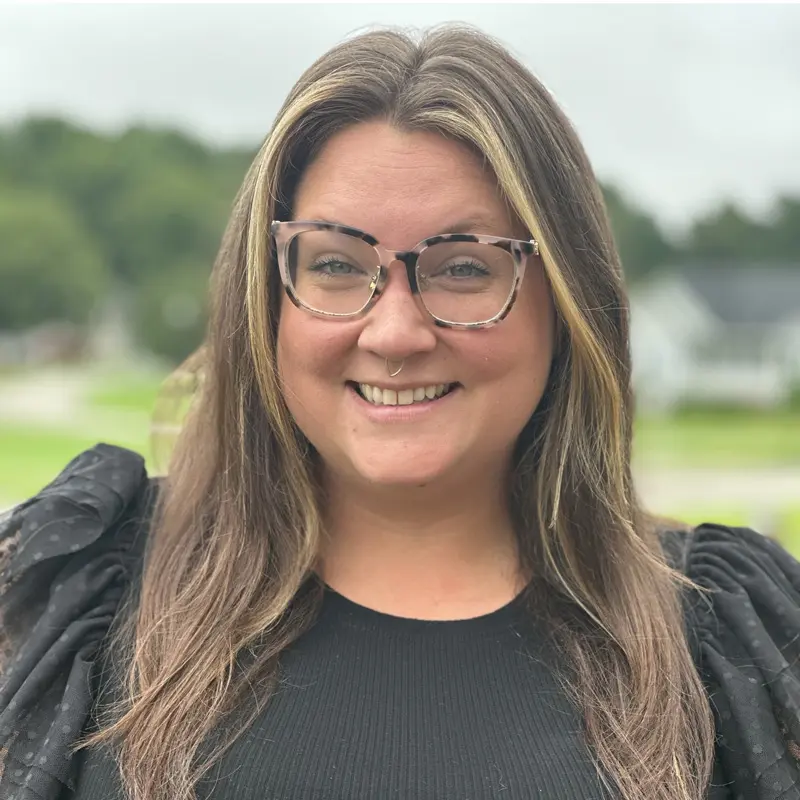
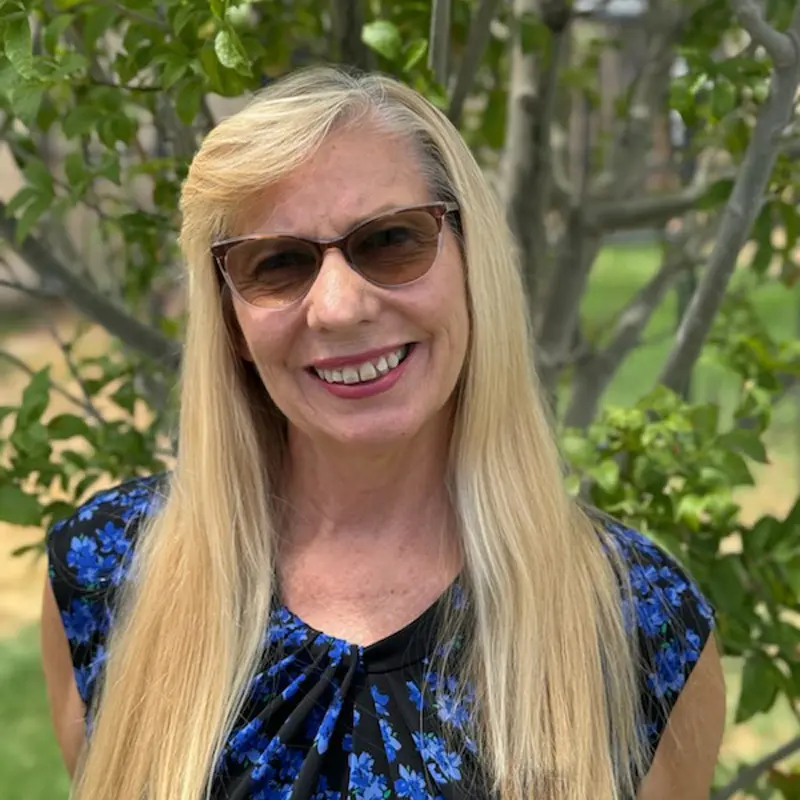
MA, BCBA, LBA, Chief of Staff @ Cardinal Pediatric Therapies
Alice has spent more than six years at Cardinal, supervising behavior analyst trainees and working with families as a whole unit. She first worked with ABA as a teenager, supporting twins with autism at home and later at school.
In-clinic ABA therapy services give your child a predictable day in a space set up for learning.
There’s a daily schedule, a fun start with their therapist, focused time on goals, and social practice like group games and lunch with other kids. And it’s a medically indicated, insurance-funded service. Not daycare.
Alice Okamoto, a BCBA and Cardinal’s Chief of Staff, explains how Cardinal’s clinics work and answers the worry parents bring up most.
Key takeaways
Lunch and group games are part of the therapy, not a break from it.
Clinic rooms get set up around what each child is working on.
For some kids, that structure means picking up new skills faster.
Peers and other adults in the clinic help new skills carry over to everyday life.
Every hour works toward goals in your child’s plan, which is what makes it therapy and not daycare.
Clinic or Home: Where Families Start
Maybe you’ve booked a clinic tour and you’re still reading up on in-home ABA therapy. Totally normal. Cardinal offers both as part of its ABA therapy services, and the right one depends on your kid, not on which one sounds better.
What usually decides it:
Your child’s age and goals. A BCBA recommends a setting after assessing your child.
Whether your child needs practice with other kids.
How busy your house is during the hours therapy would happen.
Your family’s schedule.
If a clinic is on your list, here’s what the day looks like and why it works so well for some kids.
What a Day of In-Clinic ABA Therapy Looks Like
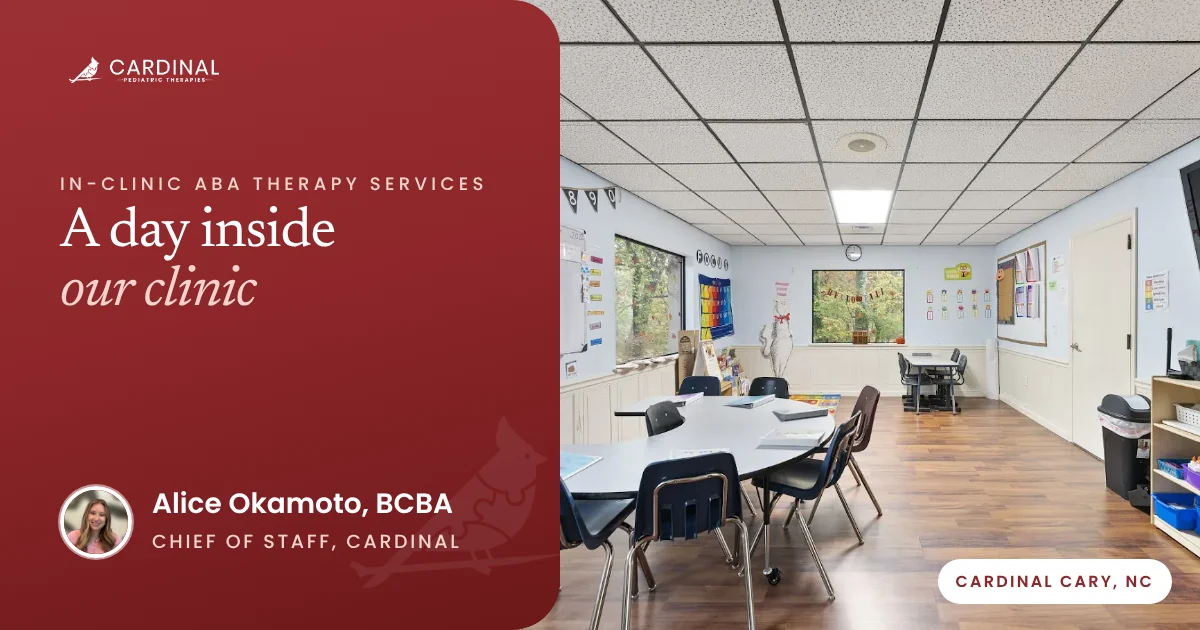
A day of in-clinic ABA therapy at Cardinal runs on routine: your child arrives, starts with something fun alongside their therapist, works on the goals in their plan, then joins group games and lunch with other kids. Kids walk in to the same routine every day, and that’s on purpose.
“We try to really create as much routine and consistency as possible.”
Alice Okamoto
The details shift with your child’s age and goals. Most days move through four parts:
Arrival. Belongings go away, the same way every time.
Pairing. The day opens with something fun with the therapist. Alice calls it “starting the session off in a fun and engaging way,” and it keeps the relationship strong before any work starts.
Goals. Then it’s into the goals written into your child’s program, with data taken as they go.
Group time. Social skills practice, like a group game, and lunch together with other kids.
That last part is hard to copy at home. Lunch with friends is therapy too. It just doesn’t look like it.
What a Clinic Can Do That's Harder at Home
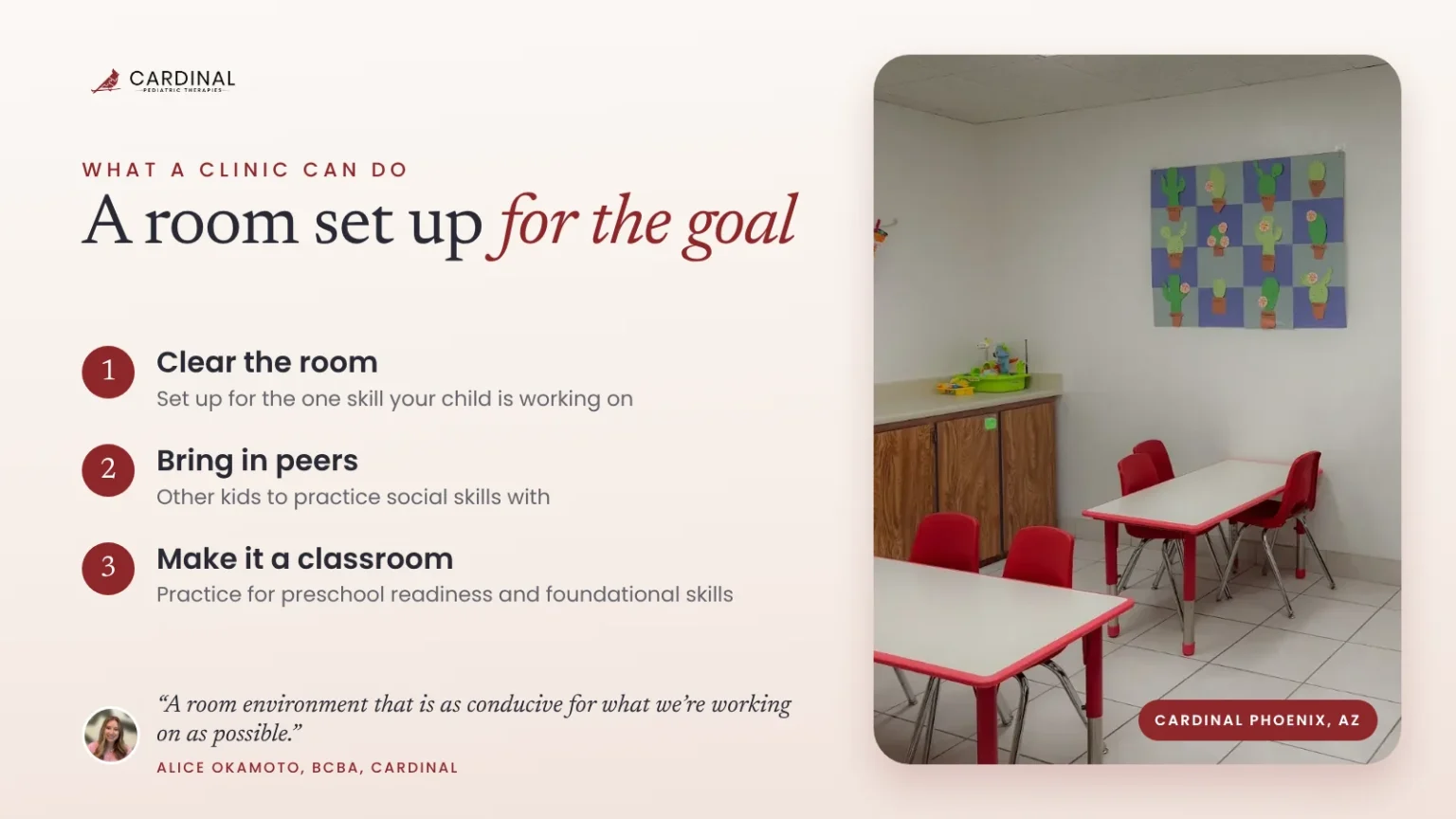
A clinic can do two things that are harder at home: therapists can set up the room so your child’s target skill keeps coming up, and they can keep out everyday distractions. We asked Alice what a clinic offers that home doesn’t. Her first answer was control over the room.
“We’re able to really manipulate the environment to contrive opportunities for running goals and working on the program the best that we need to.”
Alice Okamoto
Put simply, therapists can arrange a room so the skill your child is working on keeps coming up. Some clinic rooms are even set up like a classroom, with the kind of structure you’d see in preschool classroom activities for kids with autism.
The other half of her answer was about what a clinic leaves out. At home, therapy shares the space with:
The TV on in the next room for a sibling
Parents coming in and out
The dog barking
None of that means something is wrong with your home. In Alice’s words, “It’s just all very natural things that happen at home. And we’re able to limit, obviously, some of those things in the clinic.” For a child learning something brand new, every interruption is a chance to practice that gets lost.
Why Structure Helps Some Children Learn
Structure helps some children learn because a predictable day leaves more time and attention for practice. With fewer surprises and interruptions, a child gets more repetitions on each goal. Asked what all that structure gives a child, Alice didn’t hesitate: “the potential to be able to pick up new skills, maybe faster.”
A kid who knows what comes next isn’t spending the morning watching the door, so more of the day goes to learning. Alice listed what a structured clinic day adds:
More repetition
More consistency
More of the routine and schedule worked through
More of the goals and targets reached each session
Hours matter too. A National Research Council report set a recommended weekly minimum of intervention for young children with autism (National Research Council, 2001).
That’s a guideline, not a prescription. Your child’s BCBA recommends hours after an assessment, so the right number for your child may be different.
Wondering what a clinic day would look like for your child?Talk with our team and we’ll walk you through it.
Does In-Clinic Mean Less Individual Attention?
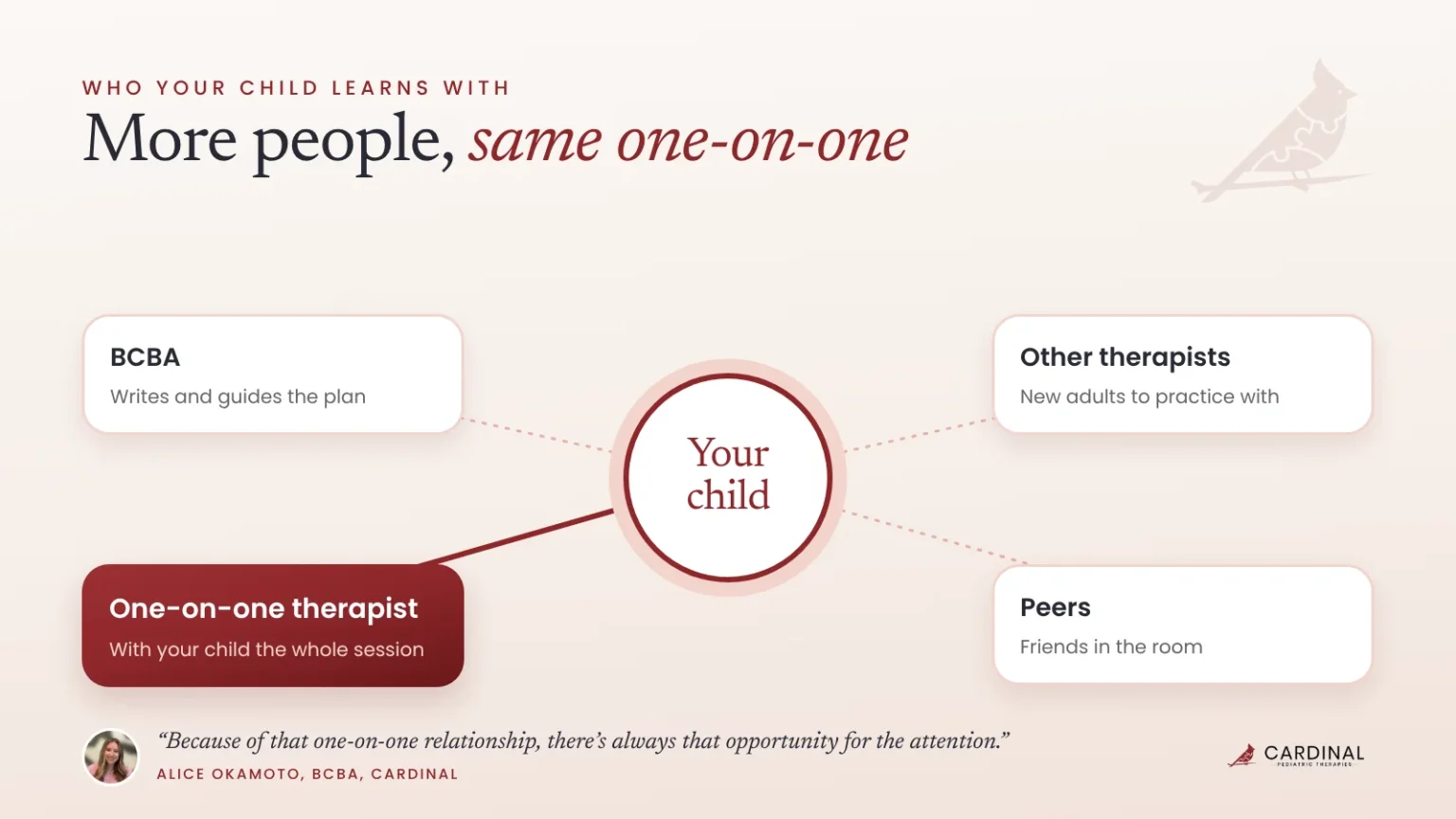
No. Most children in Cardinal’s clinics still have their own one-on-one therapist for the whole session, and that therapist stays focused on your child’s goals. It’s a fair worry, since more kids in the building can sound like less time for yours. Alice’s answer is short.
“So most of our clients do have the one-on-one therapist... they’re getting that one-on-one attention throughout their session and throughout their day.”
Alice Okamoto
A clinic adds people to your child’s day. It doesn’t take away the one-on-one ABA services at the center of every session.
Those extra people turn out to be useful. Alice pointed to “opportunities to provide generalization to other adults, more peers.” Generalization means a skill your child learned with one person shows up with other people and in other places too. In practice, that’s a skill being used:
With a different adult, not only their own therapist
With peers, during group games and lunch
Back home, during family time and playdates
A skill that only works with one person in one room isn’t finished yet. A clinic gives it more places to get tested.
In-Clinic ABA Is Not Daycare
In-clinic ABA is not daycare because every hour works toward goals in your child’s treatment plan, with data taken and progress reviewed by a BCBA. Alice is kind about this one. She gets why it can feel that way. Parents want to know their child is “in a safe environment with people that they trust.”
But, as she put it, “we are much more than daycare and babysitting.”
What makes it therapy, according to Alice:
It’s an insurance-funded, medically indicated service.
It needs consistency in services, so your child keeps building on the last session.
It depends on “communication and transparency with parents, school teams, other related providers.”
At Cardinal, your child’s goals and progress get reviewed every six to twelve weeks. In Alice’s words, kids in the clinic “are working on really, really important things throughout their day at therapy.”
In-Clinic ABA Therapy Services at Cardinal
Cardinal offers in-clinic ABA therapy services in four clinics across North Carolina and Arizona, each set up for structured learning and group practice, and every child there has a BCBA guiding their plan and a therapist working with them directly. Here’s what that looks like across our locations:
Clinics: Cary, Clayton and Wilmington, North Carolina, and Phoenix, Arizona
The team: BCBAs, RBTs and specialists trained in early childhood and autism
Center-based ABA therapy, also called in-clinic or clinic-based ABA, is ABA delivered at a therapy center instead of at home. Your child follows a daily routine with a trained therapist, works on goals from their treatment plan, and practices social skills with peers in rooms set up for learning.
How often are goals reviewed in in-clinic ABA?
At Cardinal, your child’s goals and progress get reviewed every six to twelve weeks. The BCBA looks at the session data, updates goals your child has met, and adjusts anything that isn’t working, so the plan keeps up with your child as they grow.
Can my child do ABA in the clinic and at home?
Often, yes. Some kids get their therapy at the clinic while parent training happens at home. Alice told us the team stays flexible about “going in home and also working with parents in that natural environment.” What’s possible also depends on your plan and your BCBA’s recommendation.
Where are Cardinal's ABA clinics?
Cardinal has ABA clinics in Cary, Clayton and Wilmington, North Carolina, and Phoenix, Arizona. If a clinic isn’t close by, in-home and community ABA is available across North Carolina, Arizona and Texas, so your child can still get care in the setting that fits your family.
Is in-clinic ABA therapy covered by insurance?
Often, when ABA is medically necessary. Plans differ on what they cover, including which settings and how many hours. Cardinal can give you a quote of benefits so you know what your plan covers, and what you might owe, before your child starts.
Regional Operations Director @ Cardinal Pediatric Therapies
Mike Henderson, PhD, LBA, BCBA-D, is the Regional Operations Director at Cardinal Pediatric Therapies. With over two decades of experience in behavior analysis and organizational leadership, he focuses on mentoring teams and fostering a culture of collaboration, growth, and excellence in client care.
MA, BCBA, LBA, Chief of Staff @ Cardinal Pediatric Therapies
Alice has spent more than six years at Cardinal, supervising behavior analyst trainees and working with families as a whole unit. She first worked with ABA as a teenager, supporting twins with autism at home and later at school.
Mike Henderson, PhD, LBA, BCBA-D, is the Regional Operations Director at Cardinal Pediatric Therapies. With over two decades of experience in behavior analysis and organizational leadership, he focuses on mentoring teams and fostering a culture of collaboration, growth, and excellence in client care. Mike believes strong leadership and supportive systems are essential for helping clients, families, and providers succeed together.
Felicia Freeman
Clinic Manager
I am Felicia Freeman, the Clinic Manager for Cardinal Pediatric Therapies. I have been in ABA for several years now and am passionate about the community that we serve. I started out as an RBT, decided to go the administrative route, and worked my way up to managing clinics. I choose this field every day because I enjoy making a meaningful impact in the lives of our clients and building strong teams that change lives.
Amanda Dean, MA, BCBA, LBA
Johnston County, NC
Amanda graduated from The Chicago School of Professional Psychology in 2018 with her Masters in Psychology. She proceeded to complete her graduate certificate in ABA and became a BCBA in November 2020. Amanda has a passion for behavior reduction, tolerance training and functional communication training. She enjoys spending as much time as she can with her 3 children and husband. When she’s not working, Amanda is very involved in her local Pop Warner Cheerleading program where she is the Assistant Cheer Director and a head coach.
Becky Fronheiser
Operations Director
Arizona
Becky has worked in behavioral health for 7 years. She joined Cardinal in the spring of 2024. Becky is grateful for the opportunity to work with such a passionate group of people and looks forward to supporting families with their specific ABA needs. In her personal time, she enjoys spending quality time with her husband, 6 kids and 4 grandkids and loves to travel and relax on the beach.
Matthew Wilkinson
Operations Director
Cary, NC
Matthew holds a bachelors degree from the University of Utah, Medical Degree from the Autonomous University of Guadalajara and an MBA from Western Governors University. He has worked in the pediatric field for the majority of his professional life and has a passion for helping bring the best care to children in need. He enjoys spending time with his wife and three children and day trips to the coast.
Trisha Iannotta Bieszczad, PsyD., BCBA
Triad, NC
Trisha is a Board Certified Behavior Analyst (BCBA) with extensive expertise since 2016 in applying behavior analytic principles to improve the lives of children and adolescents. Her professional journey began with a doctoral degree in clinical psychology, emphasizing child and adolescent development. This foundation has equipped her with a deep understanding of psychological theories and practices, which she seamlessly integrates into her work as a BCBA. Outside of her professional endeavors, Trisha enjoys reading, spending time outdoors with her family & trying out new restaurants. Trisha’s dedication to both her career and personal interests reflects her commitment to continual growth and enrichment, both professionally and personally. Her multifaceted background allows her to approach each aspect of her life with a blend of expertise, enthusiasm, and a genuine appreciation for learning and exploration.
Tina Lee
Director of Finance
Tina Lee is the Finance Director for Cardinal with a variety of experience in the Healthcare Industry for over 13 years. She is compassionate and always eager to assist where she can. In the ever-changing Healthcare environment, Tina has played a vital role in putting processes in place to obtain high efficiency outcomes to help our clients get the care they need. Tina enjoys the outdoors and loves spending time with her family.
William Evans
Director of Outreach and Recruitment
William is a UNCW Graduate who started his professional career working in Marketing and Recruiting for a local technology company before looking for an opportunity to take those skills and help others. In his spare time he plays hockey, including annually for the North Carolina Autism Hockey Tournament, which is dedicated to the raising money and awareness for organizations helping local families with children diagnosed with autism.
Alice Okamoto, MA, BCBA, LBA
Chief of Staff
Alice has been with Cardinal for over 4 years and has worn many hats along the way! Alice has a passion for working with clients and families as a unit, supervising behavior analyst trainees, and collaborating on strategic initiatives to ensure clinical efficiencies. Alice‘s professional experience began with ABA in a school setting, and has worked in schools, homes, and clinics throughout the years while enjoying collaboration with related providers. In her free time, Alice enjoys traveling, exploring parks with her dog, Oliver, and trying new restaurants.
Darrin Miller
CEO
Darrin has dedicated his education and career to the field of behavioral health. As a licensed therapist and master’s in clinical counseling he works to create solutions that improve the lives of those impacted by Autism Spectrum Disorder at a local, state, and national level. He strives to create a culture of caring and empathy while innovating solutions for improving families’ access to quality care as quickly as possible.