
If you’re looking for preschool autism classroom activities, you probably want more than a generic list; you want activities that actually build the skills your child will need once they’re sitting in a real classroom.
Below are practical, play-based activities organized by the skill each targets, along with the reasoning behind why they work, based on the same ABA principles Cardinal uses in our classroom readiness program.
Why These Specific Skills, and Not Just “Fun Activities”
A lot of activity lists online are really just fun ideas with autism attached as a label. These are different. Each one below is built around a specific classroom skill: communicating without a meltdown, taking turns without a fight, moving from one activity to the next without shutting down.
Those are the skills that predict how smoothly the first weeks of school actually go, more than knowing colors or shapes.
Our article on what a classroom readiness program actually is goes deeper into how these skills are formally built, but you can absolutely start practicing them at home.
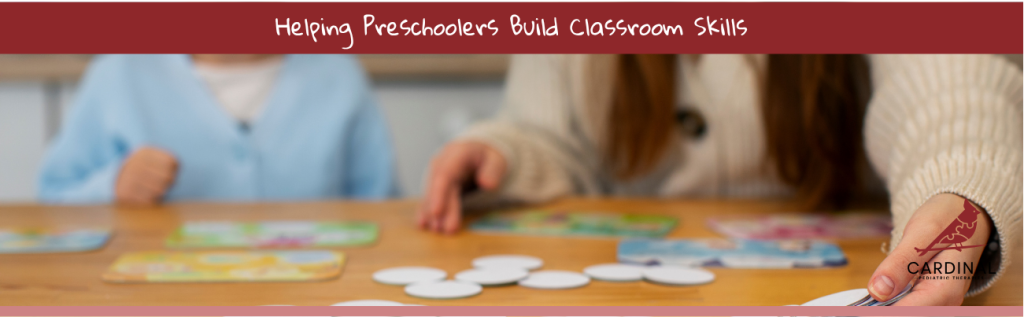
Communication Activities
| Activity | What it builds |
| Choice boards at snack time, “do you want crackers or grapes” | Requesting wants without frustration, a foundational classroom skill |
| Narrating play out loud as you play alongside your child | Modeling language your child can borrow and reuse |
| “First, then” visual boards for any two-step activity | Predictability, which reduces the anxiety that often triggers meltdowns |
| Simple call-and-response songs with a pause for your child to fill in the word | Low-pressure verbal participation in a group format |
Start small. A choice between two things is a communication opportunity even if your child only points. The goal is participation, not perfect sentences.
Turn-Taking and Group Play Activities
- Rolling a ball back and forth. About as simple as it gets, and it’s a real turn-taking rep every single time.
- Building a tower together, one block at a time. Forces a wait, which is exactly the skill a circle time or group activity will ask for.
- Board games with an obvious visual turn marker. A spinner or a “my turn” card removes the ambiguity that causes most turn-taking conflicts.
- Parallel play with a shared bin of toys. Not every group skill starts with direct interaction. Sitting near another child doing a similar activity is a real, valid first step.
Following Instructions and Transition Activities
Transitions are where a lot of preschool mornings fall apart, and they’re also one of the most trainable skills on this whole list.
Practicing instructions
Start with one-step instructions that your child already reliably follows (“give me the cup”), and reinforce them immediately.
Once that’s solid, move to two-step (“put the cup on the table, then sit down”). This is the same building-block approach, called task analysis, that a BCBA uses to design any new skill, breaking it into pieces small enough to succeed at consistently.
Practicing transitions
- Use a visual timer or a 5-minute warning before switching activities
- Give the next activity a name your child can anticipate, “next we’re doing puzzle time,” not just “okay, time to stop”
- Practice small transitions at home first, snack to playtime, before expecting a smooth transition in a group setting
- Reinforce the transition itself, not just the new activity. A quick “you switched activities so fast!” matters
A Note on Sensory Play
Sensory activities are a huge and genuinely important category on their own, things like textured bins, movement breaks, and calming tools. We’ve covered that ground separately in our article on sensory activities for preschoolers with autism, so we kept this list focused on communication, turn-taking, and transitions instead of overlapping with it.

How Cardinal Builds on These Activities
The activities above are genuinely useful on their own, and many parents see real traction just from consistent practice at home. What a classroom readiness program adds is structure, repetition, and a trained set of eyes noticing exactly where a specific child gets stuck.
Our classroom readiness program runs these same categories of skills: communication, turn-taking, transitions, following group instruction- inside a group setting that mirrors an actual classroom, with a BCBA tracking what’s working and adjusting the plan as your child progresses.
If home practice feels like it’s plateaued, or you want a clearer read on where your child actually stands, that’s exactly the kind of thing worth a quick conversation.
Reach out here, and we’ll talk through what would help most.
Frequently Asked Questions
What activities help autistic preschoolers with transitions?
Visual timers, verbal warnings before a switch, and naming the next activity in advance all help. Practicing small transitions at home, like moving from snack to playtime, builds the same skill needed for bigger classroom transitions later.
How can I help my nonverbal preschooler participate in group activities?
Parallel play, choice boards, and physical participation in games like rolling a ball all count as real participation, even without spoken language. The goal is inclusion in the activity, not verbal output, and communication support can build alongside it.
What is task analysis in ABA therapy?
Task analysis means breaking a skill into small, sequential steps a child can succeed at one at a time, rather than expecting the whole skill at once. It’s the same method used to teach anything from following instructions to getting dressed independently.
How many classroom-type activities should we practice at home each week?
There’s no fixed number. A few short, consistent sessions, five to ten minutes, several times a week tend to work better than one long session. Consistency and immediate positive reinforcement matter more than duration.
Why does play-based learning work better than table-based drills for some kids?
Not every child learns best at a table. As Cardinal’s team puts it, much of therapy is naturalistic, meaning skills are taught through play, on beanbags, or in whatever setting the child is already engaged in, rather than just seated instruction.